
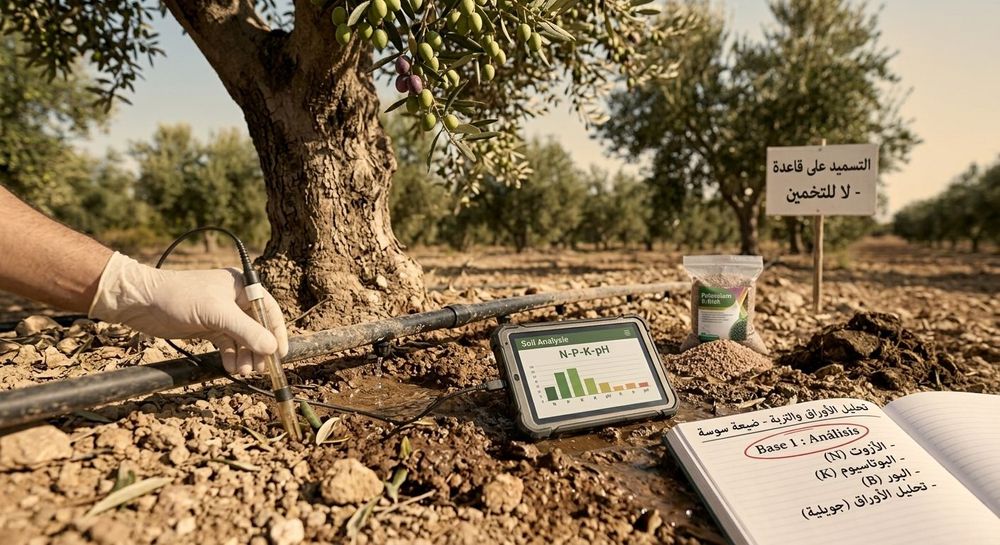
Olive Tree Fertilization in Tunisia: Calendar and Timing According to Growth Stages
Olive tree fertilization must be adapted to the tree's needs, soil type, cultivar, age, planting density, rainfall, irrigation water quality, and expected yield. There is no universal program that applies to all olive groves. The best approach combines soil analysis, leaf analysis, and monitoring of tree health and production.
1. Before Fertilizing: Assess Nutritional Needs
Before choosing a fertilizer and application rate, the nutritional status of the trees and the characteristics of the field must be assessed. Leaf analysis helps evaluate the tree's nutritional status, while soil and water analyses help identify constraints related to limestone, salinity, or the availability of mineral nutrients.
- Cultivar: cultivars do not all respond to fertilization in the same way.
- Age and planting density: the needs of a young tree differ from those of a productive mature tree.
- Water availability: rainfall and irrigation influence fertilizer dissolution and nutrient uptake.
- Crop load: a high-yielding year (ON) differs from a low-yielding year (OFF).
- Soil: texture, organic matter, limestone content, and salinity affect nutrient availability.
Poor growth does not necessarily indicate a nitrogen deficiency. Water shortage, root problems, salinity, or a deficiency of another nutrient may also explain the symptoms observed.
2. Indicative Olive Tree Fertilization Calendar
This calendar provides general guidance for the Northern Hemisphere, particularly Tunisia. Actual dates must be adapted to the region, climatic conditions, cultivar, tree condition, and phenological stages.
November – December: After Harvest
Assess the harvest and the overall condition of the trees. Depending on the diagnosis and production system, part of the nitrogen application can be scheduled. Phosphorus should not be applied automatically every year without justification.
January – February: Before Vegetative Growth Resumes
Potassium application may be considered if analyses indicate a deficiency or if production-related needs justify it. The fertilizer must be available in the root zone, with appropriate soil moisture.
February – March: Beginning of Spring Growth
This period is important for supplying nitrogen when the tree needs it. The amount depends on analyses, tree age, crop load, soil, and irrigation. It is preferable to split applications when necessary and avoid excessive or unjustified rates.
March: Before Flowering
Boron, magnesium, or other micronutrients may be considered if analyses or symptoms justify their use. Foliar spraying is not necessary in every orchard, and excessive micronutrient applications can be harmful.
April – May: Flowering and Fruit Set
Avoid excessive fertilization, particularly with nitrogen. Successful fruit set also depends on water availability, temperature, pollination, and cultivar, not fertilization alone.
May – June: Fruit Development
In irrigated orchards, potassium can be applied in split doses through fertigation according to crop load and diagnostic results. Monitor salinity and check that water is distributed uniformly.
July – August: Pit Hardening and Fruit Development
Monitor the water and nutritional status according to the cultivar and climate. Leaf analysis in July can help prepare the fertilization program for the following season.
September – Harvest: Fruit Ripening
Avoid late nitrogen applications without justification. Irrigation adjustments must take into account tree condition, soil conditions, and the planned harvest date.
Key takeaway: the months indicated are approximate and do not replace monitoring of growth stages. Conditions differ between northern Tunisia, the Sahel, central Tunisia, and southern Tunisia, as well as between rainfed and irrigated olive groves.
3. Adapt the Fertilization Program to the Type of Orchard
Low-Density Rainfed Orchard
The priority is to monitor rainfall, crop load, leaf nutritional status, and potassium. Nitrogen should not be applied automatically; fertilization must be adapted to the diagnosis and actual production.
Irrigated, Intensive, or Super-Intensive Orchard
Water volume, expected yield, and irrigation water salinity must be monitored. Fertigation allows applications to be split, provided the irrigation system distributes water uniformly and the program meets the trees' actual needs.
Young Trees
Applications must take into account tree age, growth, root development, and soil moisture. Prefer measured, split applications: excess nitrogen can promote excessive and weak vegetative growth.
High-Yielding Year (ON)
Assess crop load and leaf nutritional status. The program must be adapted to actual production without assuming that all nutrients are deficient.
Low-Yielding Year (OFF)
Monitor vegetative growth and analysis results. When nutrition is sufficient, avoid excessive applications, particularly nitrogen.
Calcareous Soil
Monitor potassium and iron availability, as well as the possible appearance of chlorosis. The cause of symptoms must be confirmed before choosing a fertilizer or treatment.
Sandy Soil with Low Organic Matter
Nutrients may be more easily leached by water. If necessary, split applications and improve organic matter content using soil amendments suited to the soil.
Saline Irrigation Water
Analyze the water and soil, particularly electrical conductivity, sodium, chlorides, and boron, before defining a salinity management strategy.
4. The Role of the Main Nutrients
Nitrogen (N)
Nitrogen contributes to vegetative growth, leaf formation, and shoot development. A deficiency can limit growth, while an excess can promote excessive vegetative growth at the expense of tree balance and increase the susceptibility of young shoots to certain pests. The application rate and timing must take into account analyses, tree age, crop load, and water availability.
Phosphorus (P)
Phosphorus deficiency is not one of the most common problems in mature olive trees. Annual routine application is therefore not justified: it should be considered when analysis confirms an insufficient level or when a specific agronomic need has been established.
Potassium (K)
Potassium contributes to plant water regulation and fruit development. A deficiency may occur particularly under dry conditions and in certain calcareous soils. Assessment must take into account analyses, crop load, soil moisture, and the balance with other nutrients.
Calcium (Ca) and Magnesium (Mg)
These nutrients play essential roles in plant functioning. The balance between potassium, calcium, and magnesium is important because an excess of one nutrient can affect the uptake of another. Their application should be based on a diagnosis rather than routine treatment.
Boron (B)
Boron contributes to flower fertility and fruit set. However, the difference between deficiency and toxicity can be relatively narrow. Excessive application is harmful. Its use must be justified by symptoms or analyses, also taking into account the boron content of irrigation water.
Iron, Zinc, and Other Micronutrients
Leaf yellowing does not automatically indicate an iron deficiency. It may also be associated with limestone, root problems, or water quality. Soil and leaf analyses help clarify the diagnosis before any corrective treatment.
5. Leaf Analysis: An Essential Decision-Making Tool
Leaf analysis helps assess the nutritional status of olive trees. Samples are generally collected in July from fully developed leaves taken from the current year's shoots, following the laboratory's sampling protocol.
Nitrogen (N)
Among general reference values, a concentration below 1.4% is considered a possible indicator of deficiency, while some revised thresholds use 1.2%. The adequate range is given as between 1.5 and 2.0% in some references, or between 1.3 and 1.7% according to revised thresholds.
Phosphorus (P)
Some general references indicate that a concentration below 0.05% may indicate deficiency, while the adequate range is between 0.1 and 0.3%.
Potassium (K)
A concentration below 0.4% is used as an indicator of deficiency, while a concentration above 0.8% falls within the adequate range in some general references.
Calcium (Ca) and Magnesium (Mg)
Some references use concentrations below 0.3% for calcium and below 0.08% for magnesium as indicators of deficiency. Adequate values are reported as above 1% for calcium and 0.1% for magnesium.
Micronutrients
Some general references indicate values above 20 ppm for manganese, 10 ppm for zinc, and 4 ppm for copper. For boron, less than 14 ppm indicates possible deficiency, the range from 19 to 150 ppm is considered adequate, and toxicity may occur at around 185 ppm.
Sodium and Chlorine
Some references use leaf concentrations above 0.2% for sodium and above 0.5% for chlorine as possible indicators of toxicity. These results must be interpreted alongside water and soil analyses and the conditions in the orchard.
Important precaution: these thresholds come from general published references for olive trees, including some Spanish studies. They have not been specifically validated for the Chemlali cultivar or for all Tunisian regions. Their interpretation depends on the cultivar, sampling date, analytical method, and orchard conditions.
If nutrient concentrations fall within adequate ranges, an additional application is not automatically necessary. It is preferable to correct confirmed deficiencies and reassess the results with a laboratory or specialist.
6. Fertilizer Application Methods
Soil Application
This method is suitable for many orchards. Its effectiveness depends on soil moisture, root distribution, fertilizer type, and application method.
Fertigation
Fertigation allows applications to be split and their timing to be controlled, provided the irrigation system distributes water uniformly and water quality is known.
Foliar Spraying
This method can be useful in certain situations, but it does not systematically replace soil fertilization and cannot correct every deficiency. Concentrations, weather conditions, and product instructions must be followed.
Organic Matter
It can help improve certain soil properties depending on its nature, quality, and degree of maturity. Its salinity and nutrient composition must also be taken into account.
7. Conclusion
Effective olive tree fertilization is not about applying as much fertilizer as possible, but about choosing the right nutrient, the right rate, and the right timing. Leaf, soil, and water analyses, combined with monitoring crop load, irrigation, and tree condition, help control costs and prevent both deficiencies and excesses.
The final program must be adapted to the region, cultivar, tree age, planting density, production system, and analytical results. Avoid applying fixed rates without a diagnosis.