Olive Tree Irrigation and Its Impact on Yield: Key Points for Farmers
1. Water and Olive Tree Roots
Olive trees are drought-resistant, but when water shortages persist, especially in combination with heat and wind, the roots experience water stress. The tree then reduces its growth and its ability to maintain its fruit properly.
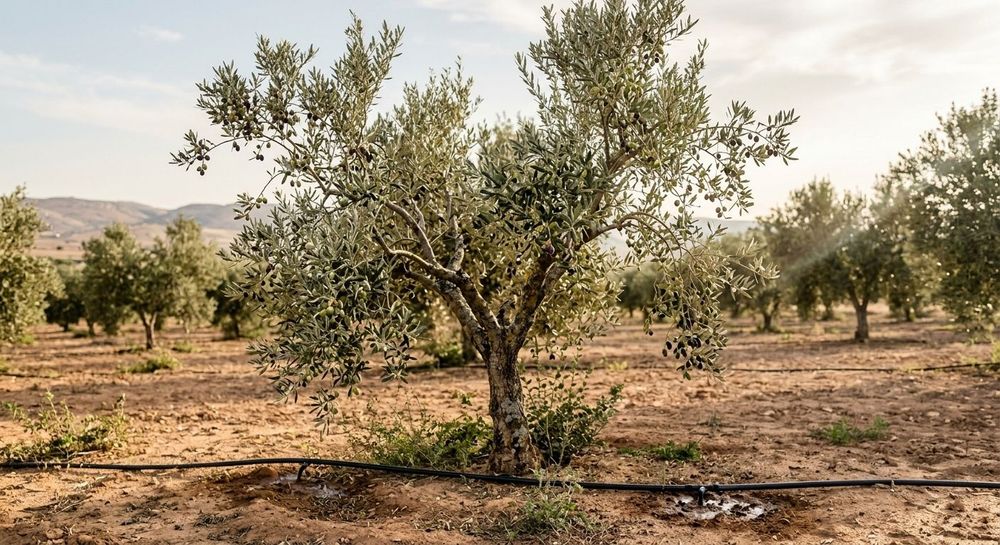
With drip irrigation, water is applied gradually to a specific area of the soil. Active roots are more abundant in areas where moisture is available. The goal is therefore not to apply large amounts of water, but to maintain a sufficient and consistent level of moisture according to the soil type and the tree's needs.
Soil management also plays an important role in water conservation. In rainfed olive groves in particular, winter tillage to a depth of approximately 18 to 20 cm can help loosen the surface layer, improve soil aeration, and conserve some moisture, provided it is adapted to the soil type and does not damage the roots.
Afterward, shallow soil cultivation can help limit evaporation and maintain a loose surface layer. However, deep or repeated tillage near the trees should be avoided, as roots may be close to the surface and easily damaged.
In some situations, organic mulching, using plant residues or suitable organic matter, can also reduce evaporation and protect the soil surface from drying out. Managing runoff also helps make better use of rainfall instead of allowing it to flow away from the field.
2. Drip Irrigation: How Should Water Be Managed?
Drip irrigation is one of the most efficient methods of using water in olive cultivation because it allows water to be applied gradually within the root zone. However, there is no single fixed amount of water that suits all olive trees.
Water requirements depend on the tree's age, canopy size, soil type, planting density, climatic conditions, and stage of development. Therefore, figures such as "500 m³/ha per irrigation" should not be considered a general rule. It is better to adjust irrigation to the tree's actual water requirements and the crop's ETc (crop evapotranspiration).
Drippers should also be distributed in such a way that the wetted soil zone can gradually expand as the tree develops, rather than keeping all the water within a small, fixed area close to the trunk.
3. Irrigation and Its Effects on Growth and Fruit Set
An adequate water supply helps olive trees maintain their leaves and produce new shoots. This is important not only for the current harvest but also for the branches that will bear part of the following season's crop.
During flowering, fruit set, and fruit development, severe water stress can increase the strain on the tree, affect fruit set, and contribute to fruit drop under severe stress conditions. The aim is therefore to avoid periods of significant water deficit while also preventing excess water and waterlogging.
Adequate moisture in the root zone also promotes nutrient uptake, since the availability and absorption of mineral nutrients depend partly on the soil's water status.
4. Irrigation, Olive Size, and Oil Content
Water availability at the appropriate stages generally promotes an increase in fruit size and flesh development. However, a larger olive does not necessarily mean a proportional increase in oil content.
In olive trees, the fruit's oil content depends on the cultivar, ripeness, crop load, and water conditions. As a general indication, it may range from around 18 to 25% of the fresh fruit weight, with significant variations depending on the cultivar and stage of maturity.
For farmers, it is therefore important to distinguish between the percentage of oil contained in the fruit and the total quantity of oil produced per tree or per hectare. Irrigation can increase total oil production even when the oil content of the fruit does not increase to the same extent.
5. How to Irrigate Successfully
- Do not wait until the tree is severely stressed by drought before applying a large amount of water.
- Adjust irrigation to climatic conditions and soil type rather than following a fixed schedule throughout the season.
- Monitor soil moisture and the root exploration zone, particularly in sandy and light soils.
- Avoid waterlogging, as a lack of oxygen in the root zone can damage the roots.
- Use drip irrigation consistently and adjust the number of drippers and irrigation duration to the tree's development.
- Conserve and make effective use of rainfall through appropriate soil management and reduced runoff, particularly in rainfed olive groves.
6. Rainfed Olive Trees: How Can Water Shortages Be Managed?
In rainfed olive groves, trees depend primarily on rainfall. There is therefore no fixed irrigation schedule that applies to every farm. The amount and distribution of rainfall, soil type, tree age, and planting density all influence water requirements.
During dry years, when a water source is available, supplementary irrigation can help trees during periods when water deficits become detrimental to growth and production. The aim is not to replace rainfall entirely, but to reduce water stress when necessary.
- Early summer: if rainfall stops early and the soil begins to dry out, supplementary irrigation may help reduce water stress, particularly after fruit set and at the beginning of fruit development.
- July and August: if drought and high temperatures persist, supplementary irrigation may help reduce water stress and support fruit development.
- September: if drought persists and the fruits are still developing, supplementary irrigation may be considered according to soil moisture and the condition of the trees.
- Autumn: after rainfall, soil moisture should be reassessed. If precipitation is sufficient, irrigation is not necessary.
In rainfed olive groves, soil management and rainwater conservation play an important role. Winter tillage to a depth of approximately 18 to 20 cm can, under certain conditions, improve aeration in the surface layer and create a loose soil layer that helps limit moisture loss. However, this depth must be adapted to the soil type and root depth.
Shallow soil cultivation or the use of organic mulch can also help reduce evaporation. In fields at risk of runoff, measures designed to retain and make better use of rainwater can be beneficial.
For rainfed olive trees, supplementary irrigation should be determined by the water deficit rather than by a fixed date. The goal is to make the best possible use of rainfall, maintain sufficient moisture in the root zone, and irrigate when the tree genuinely needs it.
Improve Your Olive Grove: Every Drop of Water Counts
Successful irrigation is not about applying large amounts of water, but about providing the right amount of water, at the right time, and in the right way. In olive cultivation, effective moisture management through drip irrigation, combined with rainwater conservation and appropriate soil management, helps preserve tree health, improve fruit development, and use water as efficiently as possible.